

What you can do with this tool
- Order the right amount of concrete: work out cubic yards from your slab size before you call the supplier.
- Count the bags you need: turn the volume into 80 lb bag counts for a DIY pour.
- Price the job: know the volume first so a quote can't surprise you.
- Check the thickness: see how one extra inch changes the volume — and the cost.
It takes seconds — and the rest of this guide shows you how to measure a pour the right way.
Use the free Concrete Calculator: enter your slab size for exact cubic yards and bag counts — open the calculator →
📌 Key takeaways
- The one formula: volume = length × width × thickness — then ÷ 27 for cubic yards.
- One cubic yard is 27 cubic feet, about 45 × 80 lb bags; one 80 lb bag yields about 0.6 cubic feet.
- Thickness is where the money hides: 4 inches for patios, 5–6 for driveways, 6+ for heavy vehicles.
- Each extra inch over 100 sq ft adds 8.3 cubic feet — about 14 extra 80 lb bags.
🏗️ Concrete Calculator — at a glance
The key numbers from this guide, in one place.
1Think in volume: the one idea behind every pour
Concrete is sold by volume, and everything else is a costume change. The trade unit in North America is the cubic yard — a cube 3 ft on each side, 27 cubic feet. Most of the world orders in cubic metres (1 m³ ≈ 1.31 yd³). The home-store unit is the bag, and every bag is quietly a volume too: an 80 lb bag yields about 0.6 cubic feet of mixed concrete, a 60 lb bag 0.45, a 40 lb bag 0.3. Cubic feet are the translator between all three worlds: volume = length × width × thickness, then ÷ 27 for yards, or ÷ the bag yield for bags.
That one formula — area × thickness — sounds too simple for the anxiety concrete causes, until you notice the trap inside it: thickness is measured in inches while everything else is in feet. The 4-inch slab over 100 sq ft is 100 × (4/12) = 33.3 cubic feet, not 400 of anything. Whole projects have been quadrupled by that single unit slip. It’s exactly why the calculator takes thickness in inches and does the /12 in code — the most common concrete error is removed by design rather than by vigilance.
Weight, for the curious and the trailer-owners: mixed concrete runs about 150 lb per cubic foot (4,050 lb per cubic yard — two tons). That number governs everything from formwork pressure to whether your pickup can legally carry a yard of bagged mix home (it can’t, in bags either: 45 × 80 lb bags is 3,600 lb).
2The formula — slab volume and bag count, with a worked example
Every concrete job is a volume sum: length times width times thickness. Then divide by 27 to get cubic yards, because one cubic yard is 27 cubic feet.
Thickness is where the money hides, so convert inches to feet first: 4 inches is 4 ÷ 12 = 1/3 ft. One 80 lb bag yields about 0.6 ft³, so divide the cubic feet by 0.6 for the bag count.
Common mistake: plugging thickness in inches straight into the formula. Four inches is not four feet — forget the ÷12 and you will order twelve times too much concrete.
3Concrete slabs: thickness is where the money hides
Most DIY concrete is a slab — patio, shed base, driveway, walkway — and slab maths is area × thickness with a thickness decision worth real money. The working standards: 4 inches for patios, walkways and shed bases (foot traffic and garden loads); 5–6 inches for driveways and anything a car parks on, usually with mesh or rebar; 6+ inches for heavy vehicles and workshop floors taking machinery. Each extra inch across 100 sq ft adds 8.3 cubic feet — about 14 extra 80 lb bags or 0.31 yd³ — so “let’s just make it six inches” is a budget sentence, not a shrug.
Under the slab matters as much as the slab: a compacted gravel base (typically 2–4 inches, ordered separately by the same volume maths) stops the slab cracking from soft spots and frost heave. And the slab’s own dimensions deserve one sceptical pass — forms bow out slightly under concrete’s pressure, and a 10 ft form that bulges to 10 ft 3 in over a long run consumes real volume. Measure the inside of finished formwork, not the plan on paper, wherever the two might differ.
Thickness is also where reinforcement lives: mesh or rebar should sit in the middle-to-upper third of the slab, lifted on chairs — steel lying on the gravel at the bottom does almost nothing. None of that changes the volume maths, but it changes whether the maths was worth doing.
4A short history of concrete
Concrete is far older than it looks. The Romans mixed lime, volcanic ash and stone into a material that could set underwater, and they used it for harbours, baths and the dome of the Pantheon, finished around 125 CE. That dome is still the largest unreinforced concrete dome in the world, nearly 2,000 years later.
The recipe was lost for centuries after Rome fell, and builders went back to plain stone and mortar. It came back in 1824, when Joseph Aspdin, a bricklayer from Leeds, patented “Portland cement” — named because the finished concrete looked like Portland stone. His cement, mixed with sand and gravel, is the base of almost all concrete poured today.
The 1900s added steel bars inside the mix — reinforced concrete — which let builders make thin floors, long bridges and tall towers. The maths stayed simple, though: length times width times thickness, just as it was for a Roman patio.
5Bags vs truck: the 1-yard dividing line
At some volume, bagged concrete stops being thrifty and starts being a punishment. The maths of the small end: one cubic yard needs about 45 × 80 lb bags (27 ÷ 0.6). Mixing 45 bags by hand or with a small mixer is a full day of heavy work — each bag lifted, opened, mixed, placed and finished before the batch starts to set. The realistic home-mixing ceiling for a fit person with a mixer is around half a yard in a session; beyond a full yard, a ready-mix truck wins on cost, time and sanity almost everywhere.
The economics run like this (US-typical, flagged as ranges): an 80 lb bag costs $5–7; a yard’s worth is $225–315 of bags. Ready-mix runs roughly $130–180 per yard plus delivery, and short-load fees punish orders under about 3–4 yards — a 1.5-yard order can carry a $60–100 surcharge that narrows the gap fast. The honest crossover most contractors cite: under ~0.5 yd³ and remote from a plant, bags win; 1 yd³ and up with truck access, ready-mix wins; in between, price both — and count your own labour as a cost, because your back already is.
Bag buyers should also know the yield figures assume the bag’s rated water and no spillage — real-world coverage runs a few percent lean, which is one more reason the waste allowance in the next section is not optional padding.
6Waste, spillage and the uneven-grade tax
Perfect forms on a perfectly level base lose about 5% of concrete to spillage, wheelbarrow residue, pump priming and the simple physics of moving wet rock. Real sites add more: the base is never perfectly level, and a slab poured over ground that dips an extra inch in the middle quietly gains that inch × the dipped area in volume — the “uneven-grade tax”, and the single most common reason DIY pours run short. A slab calculated at 1.24 yd³ can honestly need 1.4.
The standard defence is a waste allowance of 10% — 5% if your forms are tight, the grade laser-levelled and the pour simple; 15% for first pours, irregular shapes and hand mixing. Ready-mix ordering rounds to the nearest quarter or half yard anyway, which absorbs some of it — but running short mid-pour is the nightmare scenario the allowance exists to prevent: a second truck, a cold joint across your patio where the first batch had already started setting, and a visible seam for the life of the slab. Short-load fees are annoying; cold joints are forever. Order the extra.
Plan the surplus before the truck arrives: a pre-built small form — a couple of stepping stones, a pad for the bins — turns leftover concrete into an asset instead of a disposal problem. Concrete you don’t place still has to go somewhere, and washing it into the soil or drains is illegal in many places and bad practice everywhere.
7Footings, columns and other shapes
Slabs are the friendly shape; foundations add three more. Footings (strip foundations) are just long thin boxes: length × width × depth, with the length following the wall’s centreline around the building — a 40 ft run of 16-inch-wide, 8-inch-deep footing is 40 × 1.333 × 0.667 = 35.6 cu ft ≈ 1.32 yd³. Round columns and post holes are cylinders: π × r² × depth — a 12-inch-diameter, 3 ft post hole is π × 0.25 × 3 = 2.36 cu ft, about four 80 lb bags, which is why the “two bags per post” rule of thumb underfills deep holes. Steps and ramps decompose into stacked boxes, each tread its own little slab.
The calculator offers all three shapes (rectangular slab/footing, round column) because the shared failure mode — eyeballing a cylinder as if it were a box — overstates round volumes by 27% (a box’s corners are empty in a cylinder: π/4 ≈ 0.785 of the box). Fence-post jobs are the classic victim: twelve holes measured as square boxes suggests 25% more concrete than the round holes need.
Whatever the shape, the routine never changes: compute the volume in cubic feet, convert to your buying unit (÷ 27 for yards, ÷ yield for bags), apply the waste percentage, round up to the orderable quantity. Four steps, printed on the calculator’s answer, identical for a birdbath base and a house foundation.
8Pour day: the checklist that protects the maths
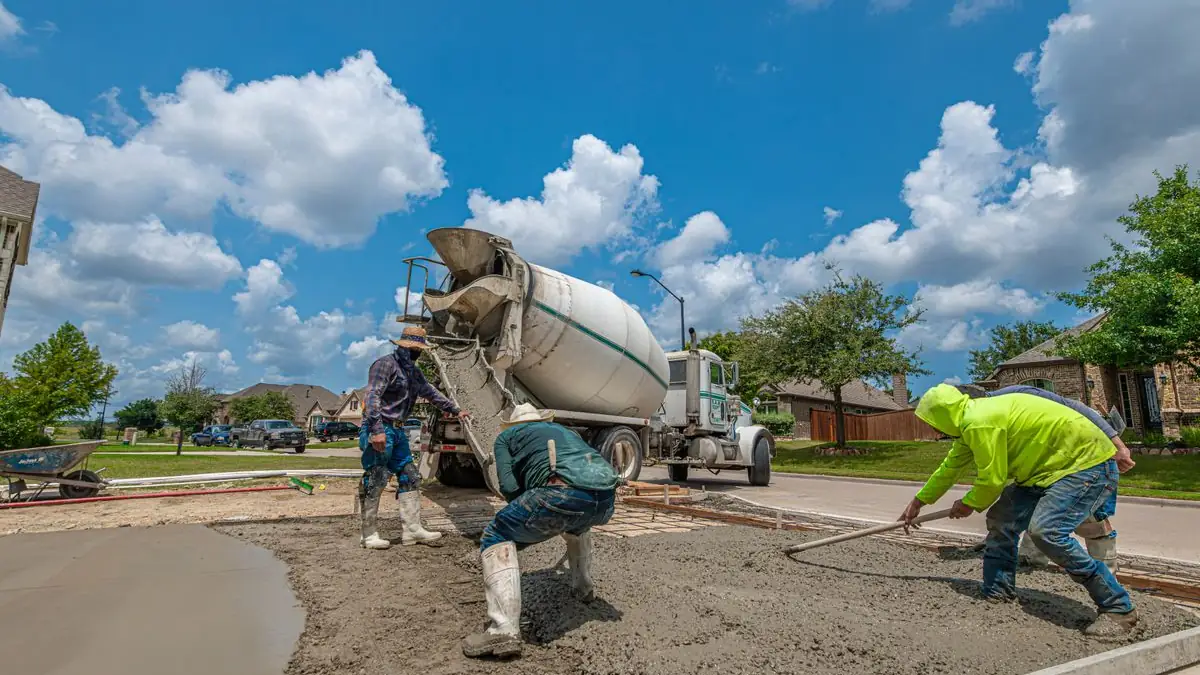
All the arithmetic in this guide buys you one thing: the right amount of concrete arriving once. Protecting that investment is a short checklist. Forms: staked, levelled, oiled or lined for release, with the inside dimensions re-measured (bulges and mistakes found now are free; found at the truck, expensive). Base: compacted, dampened just before the pour so it doesn’t suck water out of the mix. Reinforcement: mesh or rebar on chairs, not on the ground. Water: resist adding extra water to make the mix flow — every extra gallon per yard costs measurable strength (the slump/strength trade-off is real, and the ready-mix ticket’s mix design assumed discipline).
Crew and tools: concrete waits for no one — a yard placed and finished wants at least two people who’ve done it before or one who has and two who take instruction well. Screed board, floats, edger, and a plan for the truck’s route and washout spot, all settled before the drum starts turning. Curing: the pour isn’t done when it’s flat — keep it moist or covered for several days; concrete gains strength by staying wet, and most surface cracking is curing failure wearing a disguise.
Weather rules the day: pouring in hard frost or extreme heat without precautions (blankets, shade, timing) undermines the best maths. The calculator’s numbers are weatherproof; the slab isn’t.
9Worked example: a 10×10 patio, priced out
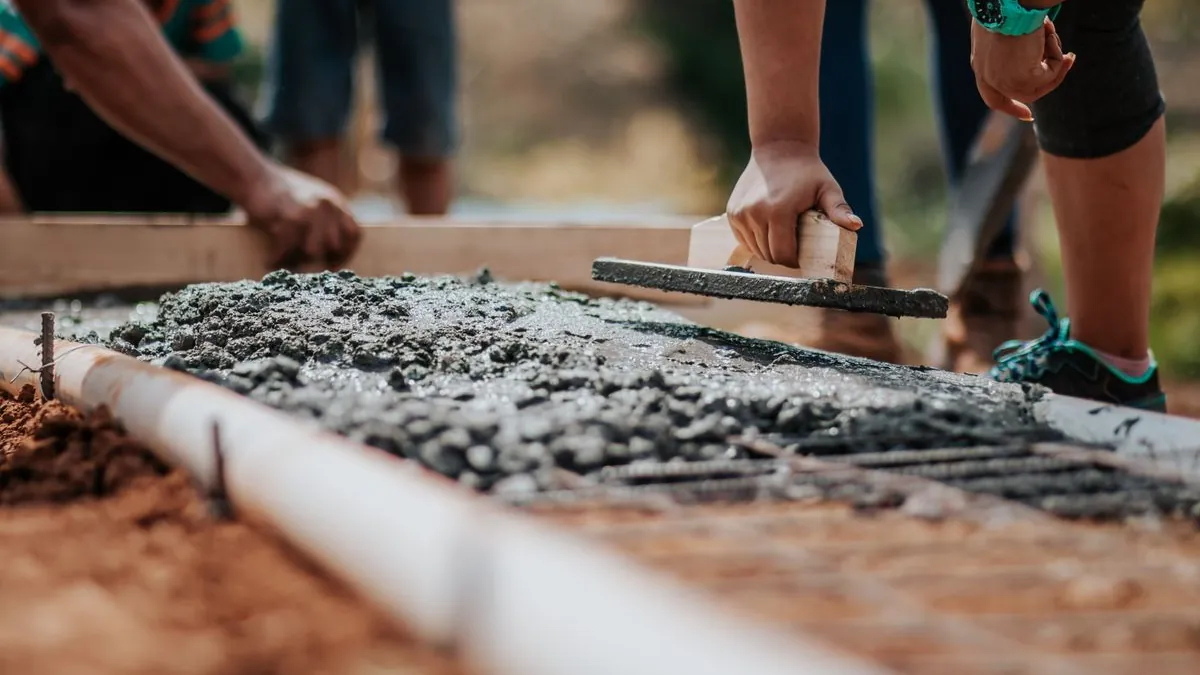
The project: a 10 × 10 ft patio, 4 inches thick. Volume: 100 sq ft × (4/12) ft = 33.3 cu ft = 1.23 yd³ (0.94 m³). With 10% waste: 1.36 yd³ → order 1.5 yd³ ready-mix, or in bags: 33.3 ÷ 0.6 = 56 bags → with waste, 62 × 80 lb bags. (60 lb bags: 33.3 ÷ 0.45 = 74 → 82 with waste. Feel the difference — this is the 1-yard dividing line in action: 62 bags is a long day; the truck starts looking wise.)
The money, roughly: bags at $6 → 62 × $6 = $372 plus your day. Ready-mix 1.5 yd³ at $160/yd³ = $240 + ~$75 delivery + possible short-load fee — call it $315–390, arriving mixed, placed in 20 minutes with a chute. At this exact size the two routes cost about the same; the truck buys your Saturday back. At half this size (a 5×6 shed base, 0.62 yd³ → 35 bags ≈ $210), bags win clearly. At double (a 20×10 driveway apron, 2.5 yd³ → 112+ bags), the truck wins by a landslide and it isn’t close.
The sneaky variant: same patio at 6 inches “for strength it doesn’t need”: volume jumps 50% to 1.85 yd³ (85 bags) — thickness is the budget dial, exactly as Section 2 warned. Four inches, compacted base, mesh in the middle: that patio will outlive the house’s next two owners.
10Frequently asked questions
How many bags of concrete do I need for a 10×10 slab?
At 4 inches thick the slab is 33.3 cubic feet. An 80 lb bag yields 0.6 cu ft, so 33.3 ÷ 0.6 = 56 bags — 62 with a 10% waste allowance. With 60 lb bags (0.45 cu ft yield) it's 74 bags, 82 with waste. At that quantity, compare against a ready-mix quote: you're at the crossover point.
Why did my pour come up short when I ordered the exact calculation?
Three usual causes: the subgrade wasn't level (dips add volume invisibly), forms bowed outward under pressure, or spillage and residue ate the margin. Exact calculations assume a perfect world; that's why the standard practice is +10% waste — and why running short (a cold joint, a second truck) costs far more than the surplus ever does.
How thick should a driveway slab be?
4 inches is the patio/walkway standard. Driveways carrying cars are typically 5–6 inches with mesh or rebar reinforcement, because wheel loads concentrate at edges and corners. Heavy vehicles, RVs or weak soil push to 6 inches or beyond — local codes and soil conditions have the final word.
What is a cubic yard of concrete in bags and in weight?
One cubic yard = 27 cubic feet ≈ 45 × 80 lb bags (0.6 cu ft each), 60 × 60 lb bags, or 90 × 40 lb bags. It weighs about 4,050 lb (roughly two tons) mixed — which is why transporting a yard of anything in a pickup isn't happening, and why the truck exists.
Can I mix concrete that's too wet without consequences?
Extra water makes placing easier and the result weaker — measurably. The water-cement ratio is a primary strength variable in every mix design; a few extra gallons per yard can cost several hundred psi of final strength and increase shrinkage cracking. If the mix is unworkable, the fix is a plasticiser or a different mix design, not the hose.
How long before I can walk or drive on a new slab?
Typically: foot traffic in 24–48 hours, light vehicles after about 7 days, full design strength at 28 days of curing (the standard reference age in concrete specs). Keep the slab moist or covered during the first days — curing is where strength and crack resistance are actually made.
iLoveUnit is a Qevryn product — free, private, no signup.
Keep exploring
Concrete is one stop on a project. These tools cover the steps around it:
Related guides
More step-by-step guides on this topic:
| Slab | Thickness | Notes |
|---|---|---|
| Patios, walkways, shed bases | 4 in | Foot traffic and garden loads |
| Driveways | 5–6 in | Cars — usually with mesh or rebar |
| Heavy vehicles, workshop floors | 6+ in | Machinery loads |
| Each extra inch over 100 sq ft | +8.3 ft³ | About 14 extra 80 lb bags, or 0.31 yd³ |
Price your pour before the truck rolls
Slabs, footings and round columns in yards, cubic feet, metres and bags — with waste allowance built in. Free, private, no signup.
🏗️ Open the Concrete Calculator100% free · No account · Private by Qevryn